I've spent the past couple of years building an application security program. This series covers the decisions involved: what the team owns, who to hire, how to measure the work, and how to fit it into an engineering organization.
The first decision is whether you need a separate AppSec team at all. A smaller company may be better served by security engineers who can cover several areas and work directly with product teams. Headcount alone won't tell you when that stops being sufficient; the number of applications, the work waiting for review, and the sensitivity of the data matter too.
When to form a dedicated team
My starting rule of thumb is one security engineer for every 100 software engineers. It is a planning assumption, not a staffing standard. At that ratio, the team has to build reusable controls and help engineers resolve recurring problems. It cannot manually approve everything.
As the company grows, dedicated AppSec ownership can make it easier to cover design reviews, testing, vulnerability triage, and remediation. The reason to add people should be a recognizable workload and a clear idea of what those people will own.
Compliance may create deadlines and funding for that work. It shouldn't be the only measure of whether the program is succeeding. A completed audit doesn't tell you whether an application enforces its authorization rules correctly or whether engineers can fix a vulnerability quickly.
Building an AppSec Team
Suppose a 1,000-person company has budget for a ten-person AppSec team. This is how I'd initially divide the roles, subject to the work the company needs covered.
One AppSec manager and one program manager
The AppSec manager sets technical priorities, supports the engineers, and is accountable for the team's work. The program manager coordinates projects that span departments: who owns a change, what is blocking it, and when the teams involved can deliver it.
I value the program management role because finding an issue and getting it fixed are separate pieces of work. Unclear ownership and missed handoffs can leave a well-understood vulnerability unresolved.
Four product security engineers
These engineers perform security reviews and penetration tests, then work with product teams on the fixes. Consulting experience can be useful here because it exposes people to different systems and requires them to explain findings to teams with different priorities.
Technical depth matters, but so does the ability to discuss a change with the engineer who has to implement it.
Two software security engineers
These roles should build and maintain software: shared security components, internal tools, and automation that removes repetitive work. Being able to read code is not enough for a role responsible for shipping it.
I would reserve these positions even when review requests are piling up. Otherwise, the team can spend all its time handling individual requests and never improve the systems that generate them.
Two vulnerability and risk management analysts
The analysts maintain a shared view of findings from scanners, penetration tests, and other sources. They coordinate triage, assign issues to the right owners, and track remediation and overdue work.
This is one of my weaker areas, which is another reason to give it explicit ownership. The team needs people who can keep the data consistent enough to answer questions about progress and where fixes are getting stuck.
Goals, Metrics, and KPIs
It is hard to attach a dollar value to a vulnerability that never became an incident. I would avoid building the team's reporting around speculative savings.
Start with the work you want to complete
I like to begin with a longer-term view of a few areas: cloud security, CI/CD, and application testing. What should each look like in five years? Then work backward to changes the team can deliver and verify in the next quarter.
The plan needs to reflect the company. An upcoming IPO, a recent incident, and a large platform migration create different priorities. A roadmap is useful when it helps the team make those choices, including which requests to defer.
Measures I'd keep
- Findings and remediation capacity. Track internal and external findings together, but don't treat a higher count as an automatic improvement. If findings accumulate faster than engineers can fix them, the security team may need to spend more time on remediation.
- Time to remediate. Review overdue issues and the reasons for delay, alongside time to fix by severity and responsible team. An average can hide a small number of important unresolved findings.
- Review coverage and recurring defects. Record which releases receive security review and which problems keep appearing afterward. Use that information to improve design guidance and shared components.
- Scanning coverage and usefulness. Know which repositories are scanned, whether the results lead to fixes, and how much triage the tools impose on developers.
Review these measures when priorities change. A metric that once helped plan work can become a reporting habit after the underlying problem has been addressed.
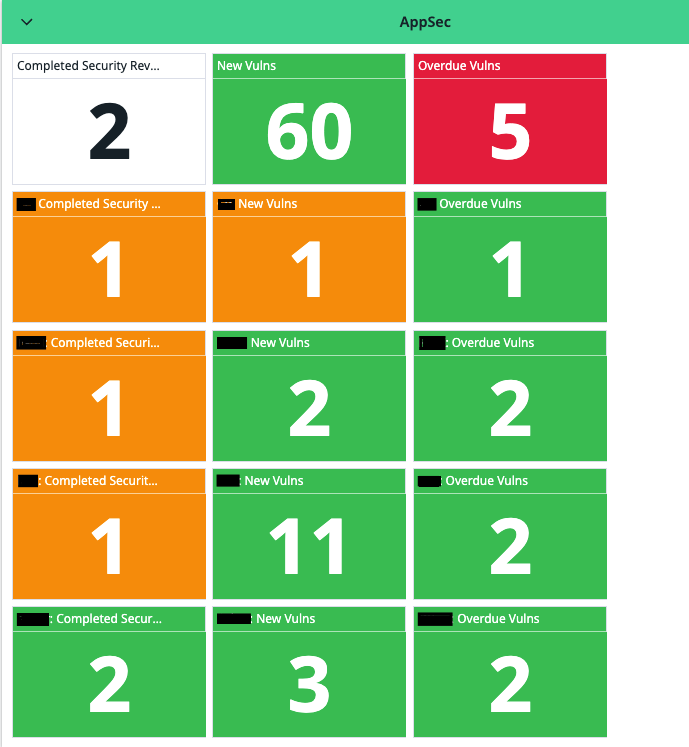
Here's an example of the Datadog dashboard my company uses in weekly reviews:
Reporting structure
My preference is for AppSec to report through a CISO or CTO with responsibility across the organization. A team housed entirely within DevOps can find its priorities and promotion criteria tied to that department, even when the most pressing security work is elsewhere.
Working inside an engineering department also has advantages. People share context, can make changes together, and learn how the systems actually operate. Whatever the reporting line, AppSec needs those working relationships. An organization chart doesn't supply them.
Budget beyond headcount
An 80/10/10 split is a starting point I like for the budget discussed here: 80% for tools, 10% for training, and 10% for team outings. It needs adjustment to the team's circumstances and shouldn't be read as a split of the company's entire security spend.
Tooling can remove substantial manual work, but only if someone can operate it and act on its results. I'd evaluate a purchase against the work it replaces and the maintenance it adds. Training needs a reserved budget too; otherwise, it is easy to postpone whenever delivery work gets busy.
The last portion gives the team time together outside its usual workload. People won't all value the same courses or activities, so leave room for different preferences.
Working with engineering
Security decisions have to account for the business the software supports. Blocking a release has a cost, and approving a risky change has a cost. The team needs to explain the issue, propose a workable fix, and identify who can accept any remaining risk.
Repeated requests are often a sign that a shared implementation would help. If teams keep making the same authentication or configuration mistake, building a supported component may be more useful than repeating the review on every project.
For broader program planning, NIST Cybersecurity Framework 2.0 provides another reference. I'd use a framework to check for gaps, then return to the practical questions: who owns the work, what can they ship, and how will we know it helped?
Written by
Matthew is the founder of PlatformSecurity and focuses on agent security. He previously led platform security at SeatGeek and security engineering initiatives at Fanatics. His work includes Checkpoint, SeatGeek’s platform for temporary, self-service access to cloud infrastructure, and security tooling built into engineers’ everyday workflows.